Most riders train forward and backward—and train their core to move, even though much of its job on the bike is to resist movement.
Most riders train forward and backward. Motocross doesn’t happen that way.
Walk through almost any gym, and most of the work happens in a straight line. Squats, deadlifts, bench presses, rows, lunges, running, cycling. There is nothing wrong with any of those movements. I use all of them.
The problem starts when that becomes the entire program.
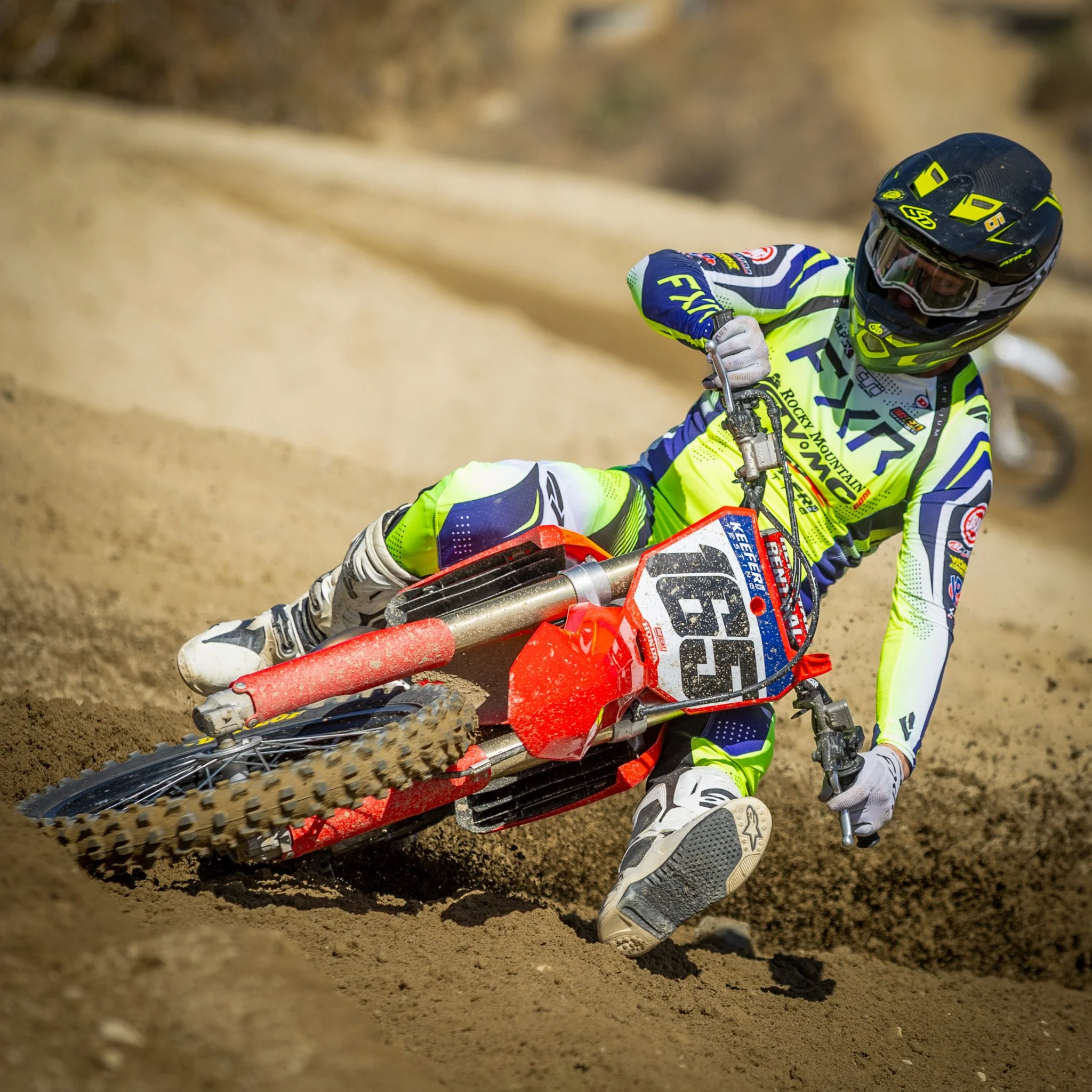
A motorcycle does not stay neatly underneath you while you produce force straight up and down. It leans, slides, kicks sideways, accelerates, decelerates, rotates and changes direction while your body constantly moves around it. A rider has to produce force, absorb force, and resist force from a lot more directions than most gym programs account for.
THREE PLANES, ONE RIDER
Human movement gets divided into three basic planes. The sagittal plane covers forward-and-backward movement, which is where squats, deadlifts, running, and cycling mostly live. The frontal plane covers side-to-side movement. The transverse plane covers rotation.
Moto uses all three constantly.
Think about what happens when the rear wheel steps sideways, when you weight the outside peg in a corner, when your upper body stays relatively quiet while the bike moves underneath you, or when your shoulders and hips have to control rotation instead of simply following the motorcycle wherever it wants to go.
Most riders already train the sagittal plane pretty well. The other two often get whatever scraps are left.
SQUATS ARE GREAT. THEY ARE NOT THE WHOLE ANSWER.
This is where people sometimes hear “train in three planes” and immediately start inventing circus exercises.
That is not what I mean.
Heavy squats and deadlifts build useful force. Strong legs and hips matter. Basic strength work gives you a foundation that balancing on a BOSU ball while somebody throws a medicine ball at your head probably will not.
But strength only helps if you can apply and control it in the positions your sport demands.
If your entire lower-body program happens with two feet planted symmetrically underneath you, you are leaving something out. On the motorcycle, one leg may carry more load than the other. Your hips may move laterally while your torso stays stable. Your upper body may rotate one direction while the bike moves another.
That is normal riding, so your strength program should expose you to at least some of those demands.
FILL THE GAPS WITHOUT MAKING IT WEIRD
You do not need to throw away your current program. Keep the big lifts and add a few movements that cover what they miss.
Split squats and other single-leg exercises force each side to produce and control force independently. Lateral lunges and lateral step variations train side-to-side loading. Suitcase carries make your trunk resist lateral flexion instead of just doing another set of crunches.
Single-arm rows and presses force you to control rotation. Pallof presses and similar anti-rotation work teach the trunk to stay organized while an outside force tries to twist it. Rotational medicine-ball throws can help you produce rotation quickly when that fits the goal.
None of this needs to look impressive on Instagram.
In fact, if your “motocross-specific” exercise requires unstable equipment, three resistance bands, and a friend filming it from two angles, there is a decent chance we have lost the plot.
WHEN WAS THE LAST TIME YOU DID AN AB CRUNCH ON A MOTORCYCLE?
Exactly.
A lot of riders say they train their core, but what they really mean is crunches, sit-ups, twists, leg raises, and other exercises where the trunk creates movement.
That is not usually what the motorcycle is asking for.
Most of the time, your trunk’s job on the bike is not to create more movement. It is to keep unwanted movement from taking over.
The rear wheel kicks sideways, and your trunk keeps your upper body organized. You brake hard, and your torso has to transmit force without folding. The bike tries to rotate underneath you, and your body decides how much of that movement to allow and how much to resist.
That is bracing. And riders do not train enough of it.
Anti-rotation work, anti-extension work, carries, asymmetrical loading, split-stance cable work, offset holds, and other exercises where the trunk has to resist motion all make a lot of sense here.
The point is not to make the gym look more “moto-specific.”
The point is to train the trunk for the job it actually has on the bike: create enough stiffness to transfer force, control unwanted motion, and still let you breathe and move normally.
A strong core is not just one that can move a lot. It is one that knows when not to.
LOOK AT YOUR OWN PROGRAM
Pull up your last week of strength work and look at it honestly.
How much of it happened forward and backward?
Probably most of it, and that is not automatically a problem. The sagittal plane should still make up a big part of basic strength training because the foundational lifts are there for a reason.
But if virtually all of your work happens there, you have an obvious hole.
You do not need 15 new exercises to fix it. Add a few movements that give you single-leg loading, lateral loading, rotation, and anti-rotation, then progress them the same way you would anything else.
Do not add complexity just so the program looks more “moto.” Add what the rider actually needs.
THE GYM SHOULD SUPPORT THE RIDING
The goal of strength training is not to recreate motocross inside the gym. You already own a motorcycle for that.
The gym gives you a controlled place to build qualities that make riding easier: more strength, better force control, greater durability, and a better ability to maintain position when the bike starts doing motorcycle things.
So squat. Deadlift. Pull. Press. Keep the big levers.
Just remember that the moment you leave the gym, your motorcycle has absolutely no obligation to move in a straight line.
Train accordingly.
—Coach Seiji